
How this founder’s unlikely path to Silicon Valley can become an advantage in industrial technology
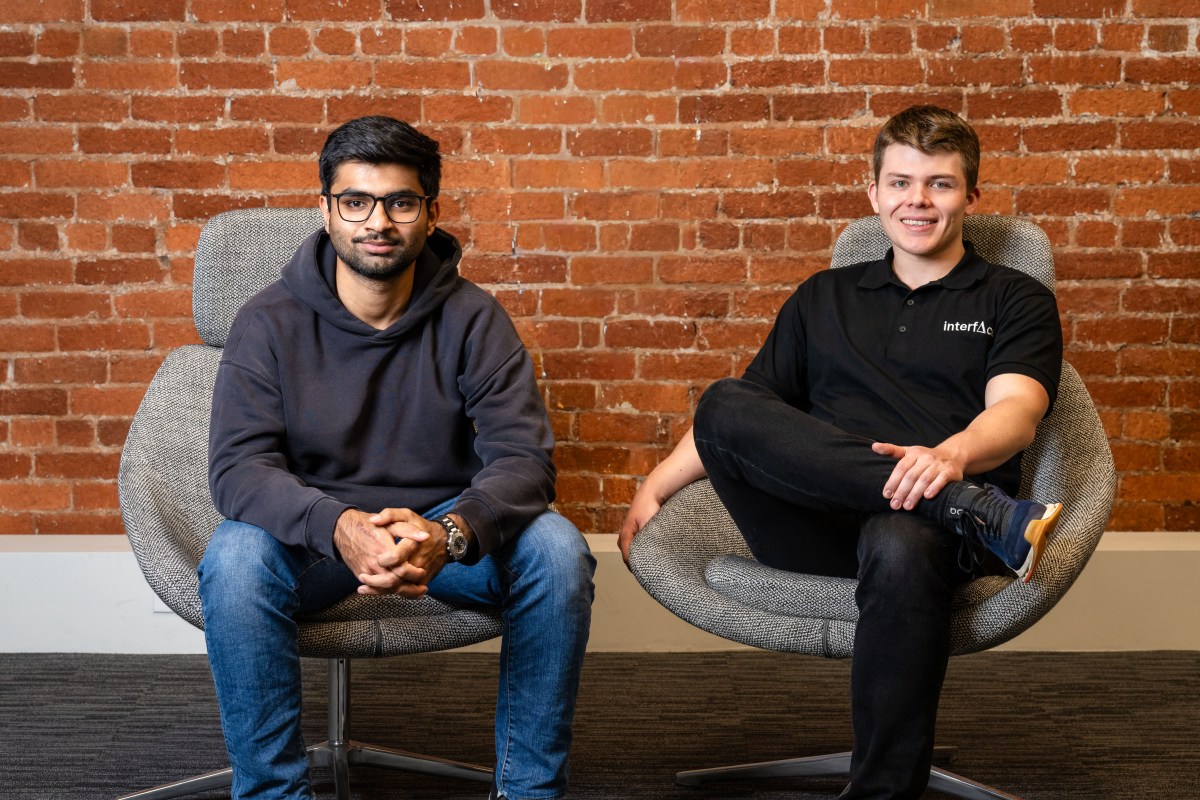
Thomas Lee Younger does not sound like your typical Silicon Valley founder.
The 24-year-old CEO of Interface, a San Francisco startup that makes use of AI to forestall industrial accidents, is a white man with a Caribbean accent and a Chinese language surname, a mix he finds amusing sufficient to say when first launched to enterprise contacts. Born and raised in Trinidad and Tobago, dwelling to vital oil and gasoline exploration exercise, Younger grew up round oil rigs and vitality infrastructure as a result of his whole household labored as engineers, passing generations after his great-grandfather, who immigrated to the island nation from China.
That background has turn out to be his calling card in area conferences with oil and gasoline executives as we speak, however it does greater than make a terrific dialog starter; it highlights a path that has been something however simple and that Younger might argue provides Interface an edge.
It was years within the making. From the age of 11, Younger was obsessive about Caltech with the depth of somebody a lot older. He watched reveals about Silicon Valley on-line, mesmerized by the concept folks might construct “something and the whole lot” in America. He did the whole lot attainable to safe acceptance, even writing his software essay about hijacking his household’s Roomba to create 3D spatial maps of his dwelling.
The physique labored — Caltech accepted it in 2020 — however then COVID-19 hit, and so did its ripple results. For one factor, Younger’s visa scenario grew to become practically inconceivable (visa assignments had been canceled and processing halted). On the similar time, his faculty fund, rigorously constructed up over six or seven years to $350,000 to cowl his training, “mainly took a success” within the sudden market crash in March of that yr.
With little time to determine his future, he opted for a less expensive three-year engineering program on the College of Bristol within the UK, finding out mechanical engineering however by no means abandoning his Silicon Valley desires. “I used to be devastated,” he says, “however I spotted I might nonetheless do one thing.”
In Bristol, Younger landed at Jaguar Land Rover, engaged on one thing referred to as human elements engineering – mainly UX design and industrial methods safety. “I had by no means heard of it earlier than I joined,” he admits. The position concerned determining tips on how to make the machines and manufacturing strains as protected as attainable, ensuring they had been “proofed” for clean operation.
The Techcrunch occasion
San Francisco
|
October 13-15, 2026
It was there, inside heavy trade, that Younger noticed the issue that will turn out to be Interface. He says the instruments many firms use to handle security documentation are both non-existent – pens and paper – or so clunky and poorly designed that staff hate them. Worse, the working procedures themselves—the instruction manuals and checklists that blue-collar staff depend on to remain protected—are error-ridden, outdated, and practically inconceivable to keep up.
Younger determined Jaguar would let him construct an answer, however the firm wasn’t . So he started planning his exit. When he realized about Entrepreneur First (EF), a European expertise incubator that recruits promising people earlier than they’ve a co-founder and even an concept, he cold-applied regardless of the 1% acceptance fee. He was admitted to primarily lifting himself up.
He informed Jaguar he was going to a marriage in Trinidad and could be away for per week. As a substitute, he went via the EF choice course of, impressed the organizers, and the day he returned to the workplace, he left. “They realized, ‘Oh, so that you in all probability have not been to a marriage,'” he laughs.
At EF, Younger met Aaryan Mehta, his future co-founder and CTO. Mehta, of Indian origin however born in Belgium, had his American dream shattered. He had been accepted to Georgia Tech and Penn, however equally could not get a visa appointment throughout COVID. He ended up finding out arithmetic and pc science at Imperial Faculty London, the place he developed AI for error detection earlier than constructing machine studying pipelines at Amazon.
“We had comparable backgrounds,” says Younger. “He is tremendous worldwide. He speaks 5 languages, very technical, nice man and we received on rather well.” Actually, they had been the one staff of their EF group to not be cut up, says Younger.
Furthermore, as we speak, they stay collectively within the SoMa neighborhood of San Francisco, though when requested about spending a lot time collectively, Younger is satisfied that this isn’t an issue given their respective workloads. “During the last week, I’ve seen (Aaryan) at dwelling for perhaps a complete of half-hour.”
As for what precisely they’re constructing, Interface’s pitch is simple: use AI to make heavy trade safer. The corporate autonomously audits working procedures utilizing giant language fashions, checking them in opposition to laws, technical drawings and company insurance policies to catch errors that would – within the worst case situation – kill staff.
Among the numbers are arresting. For considered one of Canada’s largest vitality firms, the place Interface is now deployed at three websites (Younger declines to call the model), Interface’s software program discovered 10,800 errors and improved the corporate’s commonplace working procedures in simply two and a half months. As Younger says, the identical job performed by hand would have value greater than $35 million and brought two to a few years.
One error that Younger discovered significantly troubling, he says, was a doc that had been in circulation for 10 years with the improper strain vary listed for a valve. “They’re simply fortunate nothing occurred,” says Medha Agarwal, a associate at Defy.vc, which led Interface’s $3.5 million seed spherical earlier this yr, with participation from Precursor, Rockyard Ventures and angel traders together with Charlie Songhurst.
The contracts are substantial. After first attempting results-based pricing (the ability firm “hated it,” Younger says), Interface adopted a hybrid mannequin for cost-over-location. A single contract with the Canadian vitality firm is value greater than $2.5 million yearly, and Interface has extra gasoline and oil providers clients coming on-line in Houston, Guyana and Brazil.
The whole addressable market shouldn’t be completely clear, however it isn’t small. Within the U.S. alone, there are about 27,000 oil and gasoline providers firms, in accordance with market analysis group IBISWorld, and that is simply the primary vertical that Interface needs to handle.
Periphery
Apparently, Younger’s age and background — issues which may look like disadvantages relating to extra established industries — have turn out to be his secret weapons. When he walks right into a room of executives two or thrice his age, he says, there may be preliminary skepticism. “Who the hell is that this younger man and the way does he know what he is speaking about?”
However then, he says, he delivers his “wow second,” explaining an understanding of their operations, the each day routines of their staff, and precisely how a lot money and time Interface can save them. “When you get them again, they may completely love you and defend and combat for you,” he says. (He claims that after an preliminary area go to with current operators, 5 staff requested after they might spend money on Interface, which made him significantly proud, on condition that area staff usually “hate software program suppliers.”)
Certainly, though Younger works out of Interface’s workplace in San Francisco’s monetary district, his arduous hat sits on a desk not removed from his desk, prepared for the following area go to. (Agarwal means that Younger might use a little bit extra day off in his life, recalling a current cellphone name during which Younger informed her he hadn’t seen the solar all day.)
The corporate now has eight staff — 5 within the workplace, three distant — principally engineers, plus an operations one who began simply this week. Interface’s largest problem is hiring quick sufficient to maintain up with demand, an issue that requires its small staff to make use of networks in Europe and the US.
As for what Younger makes of the San Francisco life he wished and resides now, he is shocked at how correct the Silicon Valley stereotypes turned out to be. “You see folks on-line speaking about, ‘Oh, you go to a park and the individual sitting subsequent to you has raised $50 million constructing a loopy AI agent.’ However the truth is it’s so,” he says. “I take into consideration what life was like in Trinidad. I point out these concepts to folks again dwelling and so they simply do not imagine me.”
He often makes time to get outdoor with buddies—he says they went to Tahoe not too long ago—and Interface hosts occasions like a hackathon they threw final weekend. However principally, it is work, and far of that work entails AI, similar to everybody else in San Francisco proper now.
Which makes journeys to grease rigs surprisingly enticing.
Certainly, that tough hat on the workplace is not only a sensible necessity; it is also a lure, suggests Younger. For engineers bored with constructing “a number of low-impact B2B gross sales or recruiting instruments,” as Younger places it, the promise of often leaving the Bay Space bubble to work with area operators has turn out to be a recruiting benefit. Lower than 1% of San Francisco startups work in heavy trade, he notes, and that lack is a part of the enchantment, for him and the folks he is hiring.
It is in all probability not the model of the Silicon Valley dream he spent his childhood chasing from Trinidad: lengthy hours, intense strain, limitless discussions of AI in every single place, punctuated by the occasional journey to an oil rig.
For now, although, he does not appear to thoughts. “During the last month or two, I have never been doing a lot (outdoors the workplace) as a result of there’s simply been a lot depth right here, with building, hiring, promoting.” However “I really feel very robust”, he provides.