
How to Remove the .txt File Extension in Windows 11 (4 Easy Ways)
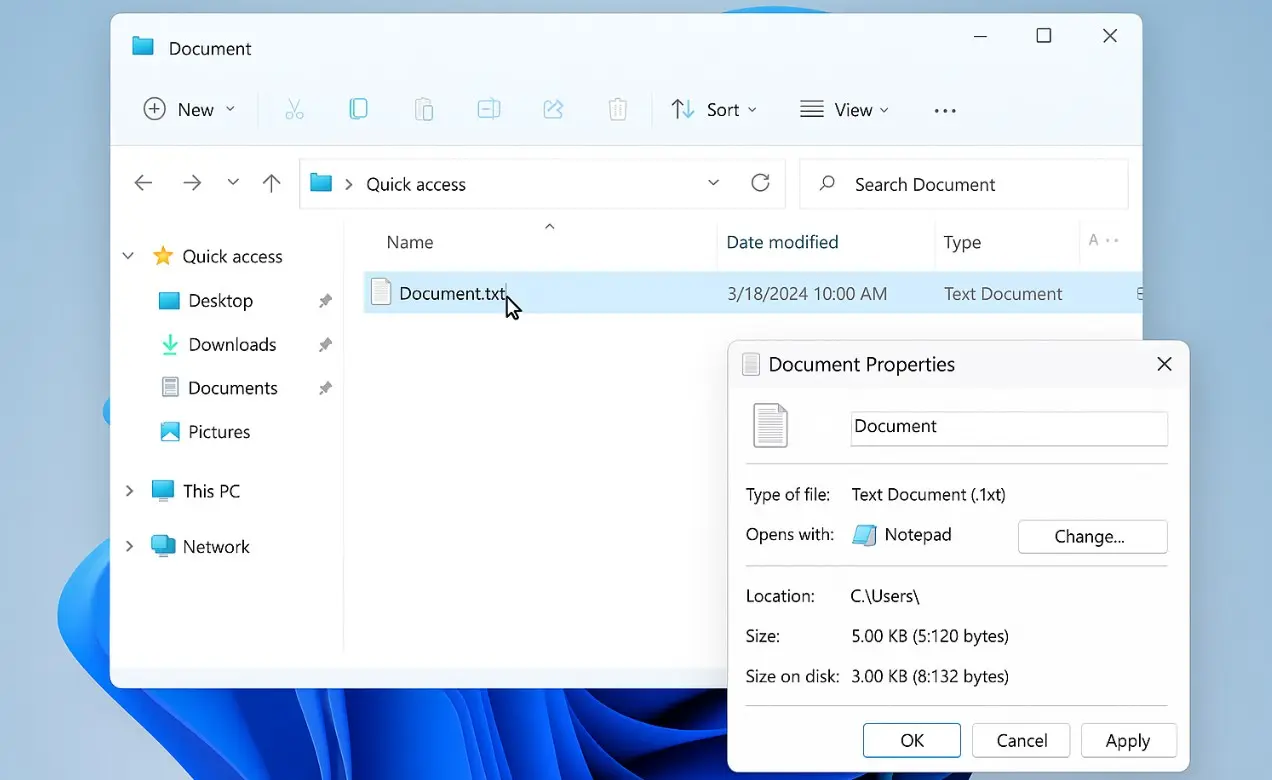
File extensions—these three or 4 letters after the dot in your file names—are Home windows’ manner of holding monitor of what kind of content material lives inside every file. Properly, every time we create a file on Home windows 11, it routinely provides these extensions to assist the working system decide which program ought to open every file. Nevertheless, generally you want extra management over your file names.
In the event you’ve ever tried renaming a textual content file and located your self pissed off by that cussed “.txt” extension that appears inconceivable to take away, then this text will help you out.
Whether or not you need to cover extensions for a cleaner look, take away them completely, or cease Home windows from routinely including “.txt” to each file you save, this information will talk about every methodology safely and clearly.
What are File Extensions in Home windows 11?
File extensions like .txt, .docx, .png, or .pdf are used not solely by Home windows however by all present working programs as a result of they determine which software ought to deal with every file. Consider them as labels on storage packing containers—with out them, Home windows wouldn’t know whether or not to open your file with Notepad, Phrase, or Paint.
Home windows shows these extensions by default in File Explorer (if they aren’t hidden) as a result of they present essential details about file varieties. When you see “report.txt,” you instantly comprehend it’s a plain textual content file. Therefore, the extensions showing on Home windows will not be simply beauty; they’re useful. Home windows depends on these extensions to find out file associations, icons, and default packages.
Right here’s the important half many customers miss: eradicating an extension incorrectly could cause extra issues than it solves. If Home windows can’t determine the file kind, it received’t know find out how to open it. You would possibly find yourself with a file that seems corrupted or unusable, though the info inside stays intact. That’s why understanding the distinction between hiding and eradicating extensions issues.
Present File Extensions on Home windows 11
By default, file extensions are hidden on Home windows 11 and different variations. Due to this fact, to alter or take away the “.txt” extensions, we first have to allow the settings that enable Home windows to show file extensions.
- Open File Explorer (Press
Win + E) - Click on on the View menu within the high toolbar.
- Hover over Present → Tick the choice File identify extensions as proven within the screenshot.

The way to Cover .TXT File Extensions by way of File Explorer ( for informal customers)
For many who have already got the File Title Extensions possibility enabled on their Home windows 11 and need to cover all file extensions, together with .txt, probably the most easy and most secure strategy is to cover file extensions reasonably than delete them. This offers you the clear file names you need whereas preserving Home windows’ capacity to handle your recordsdata correctly.
Right here’s find out how to cover all file extensions in Home windows 11:
- Open File Explorer by urgent Home windows + E or clicking the folder icon in your taskbar
- Click on the “View” button within the toolbar on the high
- Hover over “Present” within the dropdown menu
- Search for “File identify extensions” and click on to uncheck it

As soon as unchecked, all file extensions will disappear from view. Your “doc.txt” will now seem as simply “doc” in File Explorer. The extension nonetheless exists—Home windows hasn’t deleted something—however you received’t see it cluttering up your file names anymore.
Professional Tip: This setting applies system-wide, affecting all file varieties, not simply .txt recordsdata. In the event you often work with completely different file codecs and have to distinguish between them rapidly, you would possibly need to hold extensions seen. I’ve discovered that hiding extensions works nicely for informal customers however can sluggish down energy customers who handle numerous file varieties each day.
Methodology 1: Rename the File to Take away .TXT (Precise Deletion of Extension)
In the event you actually need to take away the .txt extension utterly and never simply cover it, you are able to do so by means of a easy file rename characteristic. After deleting the extension, Home windows can be unable to acknowledge the file kind routinely; nevertheless, you’ll be able to nonetheless use it with an software that helps TXT, resembling Notepad.
Observe these steps to take away a .txt file extension in Home windows 11:
- Proper-click on the textual content file you need to modify
- Choose “Rename” from the context menu (or choose the file and press F2)
- Delete all the “.txt” portion, together with the interval
- Press Enter to verify the change
- Home windows will show a warning: “In the event you change a file identify extension, the file would possibly turn into unusable. Are you certain you need to change it?“
- Click on “Sure” in the event you’re certain you need to proceed.
After eradicating the extension, Home windows will deal with the file as an unknown kind. The icon will change to a generic clean doc, and double-clicking received’t routinely open it in Notepad anymore. You’ll have to right-click and select “Open with” to pick out a program manually every time.

Methodology 2: Change File Sort With out Shedding Knowledge
Typically you don’t need to take away the extension completely, however reasonably change it to one thing else. That is significantly helpful when repurposing textual content recordsdata for completely different functions. As an illustration, you would possibly rename “webpage.txt” to “webpage.html” to transform a textual content file right into a primary internet web page, or change “script.txt” to “script.bat” to create a batch file.
The method is an identical to eradicating extensions:
- Proper-click and choose Rename
- Substitute “.txt” along with your desired extension
- Affirm when Home windows warns you concerning the change
Home windows will now deal with the file in accordance with its new extension. A file renamed from .txt to .html will open in your default browser, whereas one modified to .bat will execute as a batch script. The precise content material contained in the file doesn’t change—solely how Home windows interprets it.

Word: At all times create a backup earlier than altering extensions, particularly when coping with vital paperwork. Whereas the info stays intact, an incorrect extension may make the file briefly inaccessible in the event you overlook what you modified it to.
Methodology 3: Save a File With out .txt from Notepad (or Notepad++)
Notepad routinely appends .txt to filenames as a result of it defaults to saving as “Textual content Paperwork (*.txt)”. Nevertheless, there’s a easy workaround that forestalls this conduct completely.
Utilizing Notepad (Constructed-in):
- Write your content material in Notepad
- Click on File → Save As
- Within the “File identify” area, kind your filename with quotes: “filename”
The quotes trick works as a result of it forces Home windows to interpret your enter actually, stopping Notepad from including its default extension. This method has been documented in varied Microsoft group threads and stays probably the most dependable methodology for saving extensionless recordsdata.

Utilizing Notepad++ (Enhanced Possibility):
Notepad++ presents extra management over file saving:
- Open Notepad++ and create your content material
- Click on File → Save As
- Change “Save as kind” to “All sorts (.)”
- Enter your filename with none extension
- Click on Save
.gif)
You can too modify Notepad++’s default save conduct by means of Settings → Preferences → Default Listing to keep away from repeatedly altering the file kind.
Methodology 4: Batch Take away .txt Utilizing PowerShell or Bulk Rename Utility
When coping with a number of recordsdata, manually renaming every one turns into impractical. PowerShell gives an environment friendly resolution for bulk operations.
PowerShell Methodology:
Open PowerShell in your goal folder (Shift + Proper-click → “Open PowerShell window right here”) and run:
Get-ChildItem -Path "C:pathtofolder" -Filter "*.txt" | Rename-Merchandise -NewName { $_.BaseName }This command works by:
Get-ChildItemfinds all .txt recordsdata within the specified folder$_.BaseNameextracts the filename with out its extensionRename-Merchandiseapplies the brand new identify to every file
Word: Substitute “C:pathtofolder” along with your precise folder path. The recordsdata’ contents stay unchanged—solely the .txt extension is eliminated.
GUI Various – Bulk Rename Utility:
For these uncomfortable with command-line instruments, Bulk Rename Utility gives a graphical interface:
- Obtain and set up Bulk Rename Utility (free from bulkrenameutility.co.uk)
- Navigate to your folder containing .txt recordsdata
- Choose all recordsdata you need to modify
- Within the “Extension” part, set it to “Take away“
- Preview modifications within the “New Title” column
- Click on Rename to use modifications

This instrument presents undo performance and preview options, making it safer for customers fearful about making errors.
Video Tutorial
What Occurs When You Take away a File Extension? (Dangers & Finest Practices)
Understanding the implications of eradicating extensions helps keep away from potential points. File extensions function identifiers—they inform Home windows which software ought to deal with every file kind. Once you take away an extension:
- The file’s binary format doesn’t change – Your textual content stays textual content, simply with out the .txt label
- Home windows loses its automated affiliation – Double-clicking received’t open the file in Notepad
- File icons change to generic – The acquainted notepad icon turns into a clean doc
- Some functions could refuse to open extensionless recordsdata – They depend on extensions for file validation
Finest practices for secure extension removing:
- At all times create backups earlier than bulk operations
- Doc which recordsdata had extensions eliminated
- Maintain a PowerShell script prepared to revive extensions if wanted
- Think about hiding extensions as an alternative of eradicating them if you need cleaner shows
To revive .txt extensions later, rename recordsdata once more and add “.txt” to the top, or use PowerShell to bulk-restore them.
Troubleshooting (Frequent Issues & Fixes)
Rename Fails or Possibility Grayed Out:
- File is in use: Shut any packages that may have the file open
- Permission points: Proper-click the file → Properties → Safety tab → guarantee you could have “Full management“
- System recordsdata: Some Home windows system recordsdata can’t be renamed for defense
Editor Retains Including .txt Regardless of Utilizing Quotes:
- Make sure you’re utilizing straight quotes (“filename”), not curly quotes
- Strive the “All Information (.)” possibility as an alternative of counting on quotes
- Think about switching to a unique edito,r like Visible Studio Code or Elegant Textual content
- Some third-party Notepad replacements ignore the quotes trick
Information Grow to be Unusable After Eradicating Extension:
- The information isn’t corrupted—Home windows doesn’t know find out how to open it
- Proper-click → Open with → Select one other app → Choose applicable program
- Rename the file and restore the .txt extension to return regular performance
Superior Suggestions (Elective)
Reset File Associations:
If recordsdata not open accurately after extension modifications:
- Go to Settings → Apps → Default apps
- Scroll down and click on “Select defaults by file kind.”
- Discover your file kind and set the suitable program
Batch Restore .txt Extensions with PowerShell:
If you have to restore extensions to a number of extensionless recordsdata, this finds all recordsdata with out extensions and provides .txt to every one.
Get-ChildItem -Path "C:path" -File | The place-Object { -not $_.Extension } | Rename-Merchandise -NewName { $_.Title + '.txt' }FAQs
Allow file extensions in Explorer (View → Present → File identify extensions), right-click the file, choose Rename, delete “.txt” together with the interval, and make sure the warning.
Notepad defaults to Textual content Paperwork (.txt) format. Override this by placing your filename in quotes like “myfile” or altering Save as kind to “All Information (.*)” within the save dialog.
No, eradicating the extension doesn’t corrupt or change the file’s content material. It solely impacts how Home windows identifies and opens the file. The precise information stays intact and unchanged.
Use PowerShell command: Get-ChildItem -Filter "*.txt" | Rename-Merchandise -NewName { $_.BaseName } in your goal folder, or use Bulk Rename Utility for a graphical interface.