I tried Google’s 3 new Android XR glasses prototypes, and wow
A couple of months in the past, Meta held probably the most disastrous launch occasions in latest reminiscence, at which it unveiled the Meta Ray-Ban Show Glasses. Regardless of the wave of technical points that flat-out ruined most of the reside demos on stage, Meta nonetheless gained the day, as a result of its new AR glasses have been truly actually cool. A extra superior follow-up to the surprisingly standard Ray-Ban Meta AI Glasses ($329 at Amazon), the brand new glasses have a monocular show (which means there’s one display screen in one of many lenses), a Neural Band wrist strap that allows you to management what you see by performing air gestures, and, most significantly, a value: $799. Whereas costly, this saved Meta on the forefront of the burgeoning XR revolution by making it the primary main tech participant to have a retail-ready set of sensible glasses that appear to carry us the long run Google Glass promised us over 10 years in the past.
Sadly for Meta, there are three main issues with the brand new Ray-Bans. First, and most clearly, they’re made by Meta, an organization that few folks like or belief sufficient to put on its face laptop and feed it deeply private knowledge. Second, it’s a Meta-only platform, with app availability restricted in the intervening time to the corporate’s personal merchandise — WhatsApp, Instagram, and Fb. Third, the AI smarts of the glasses additionally come from Meta, and never from the true AI gamers proper now, particularly OpenAI and Google.
Effectively, Google invited me to San Jose final week to check out its new glasses working Android XR, the working system that first debuted with the Samsung Galaxy XR ($1799.99 at Samsung) in October. Though what I noticed are simply prototypes for actual merchandise coming later, they might doubtlessly clear up all three of Meta’s issues — instantly placing Google right into a terrific place to be the actual star of the upcoming XR revolution.
Which Android XR glasses would you like most?
631 votes
Android XR glasses: 3 completely different prototypes and approaches
Google confirmed me three completely different units of glasses, two of which it requested me to not {photograph}. Let’s begin with the one it’s prepared to point out off: Venture Aura.
Venture Aura
Venture Aura is a collaborative effort between Google and an organization referred to as XREAL, a widely known Chinese language firm in XR fan circles that has been making numerous sorts of sensible glasses since 2017. Nonetheless, none of its merchandise have ever been runaway hits or made a lot of a dent outdoors of the tech early adopter market.
Venture Aura is poised to primarily be a lighter, extra transportable model of the Galaxy XR. It’s the identical core idea: You set a headset in your face that’s tethered to a “puck” you retain in your pocket or clip to your belt. Nonetheless, as a substitute of a completely immersive VR-style headset, Venture Aura resembles conventional glasses (though undoubtedly not the type you’ll put on whereas out and about).
Venture Aura is, remarkably, virtually a 1:1 recreation of the Galaxy XR. It is simply within the type of glasses as a substitute of a headset.
Remarkably, outdoors of this bodily distinction, Venture Aura is basically a 1:1 recreation of the Galaxy XR. It runs the identical working system in Android XR and makes use of the identical chipset in Qualcomm’s Snapdragon XR2 Plus Gen 2. It affords the identical gesture controls by hand monitoring and helps all the identical apps that customers are already aware of on the Galaxy XR. It’s simply way more transportable and certain has a lot worse battery life. We don’t have precise battery particulars but, however I’m guessing this primarily based on the scale of the puck, the truth that it had each the battery and the pc in it, and the way a lot it warmed up throughout my temporary time with it.
So if Venture Aura is only a much less immersive Galaxy XR that gained’t final as lengthy in your face, what’s the purpose? Google sees it as a greater choice for vacationers, for one. Carrying a full-on VR headset on a aircraft isn’t nice, however a comparatively light-weight pair of glasses is a a lot simpler capsule to swallow. This kind of product has been XREAL’s bread and butter — simply have a look at the XREAL One Professional — so Venture Aura makes excellent sense from that angle. Moreover, there might be choices for this away from the strictly client area. For instance, giving Venture Aura to a museum customer for a guided digital tour makes much more sense than handing them a Galaxy XR.
Though Venture Aura doesn’t have a retail identify, value, or set launch date but, Google advised me we are able to anticipate a full launch in 2026.
Monocular XR glasses (and an audio-only counterpart)
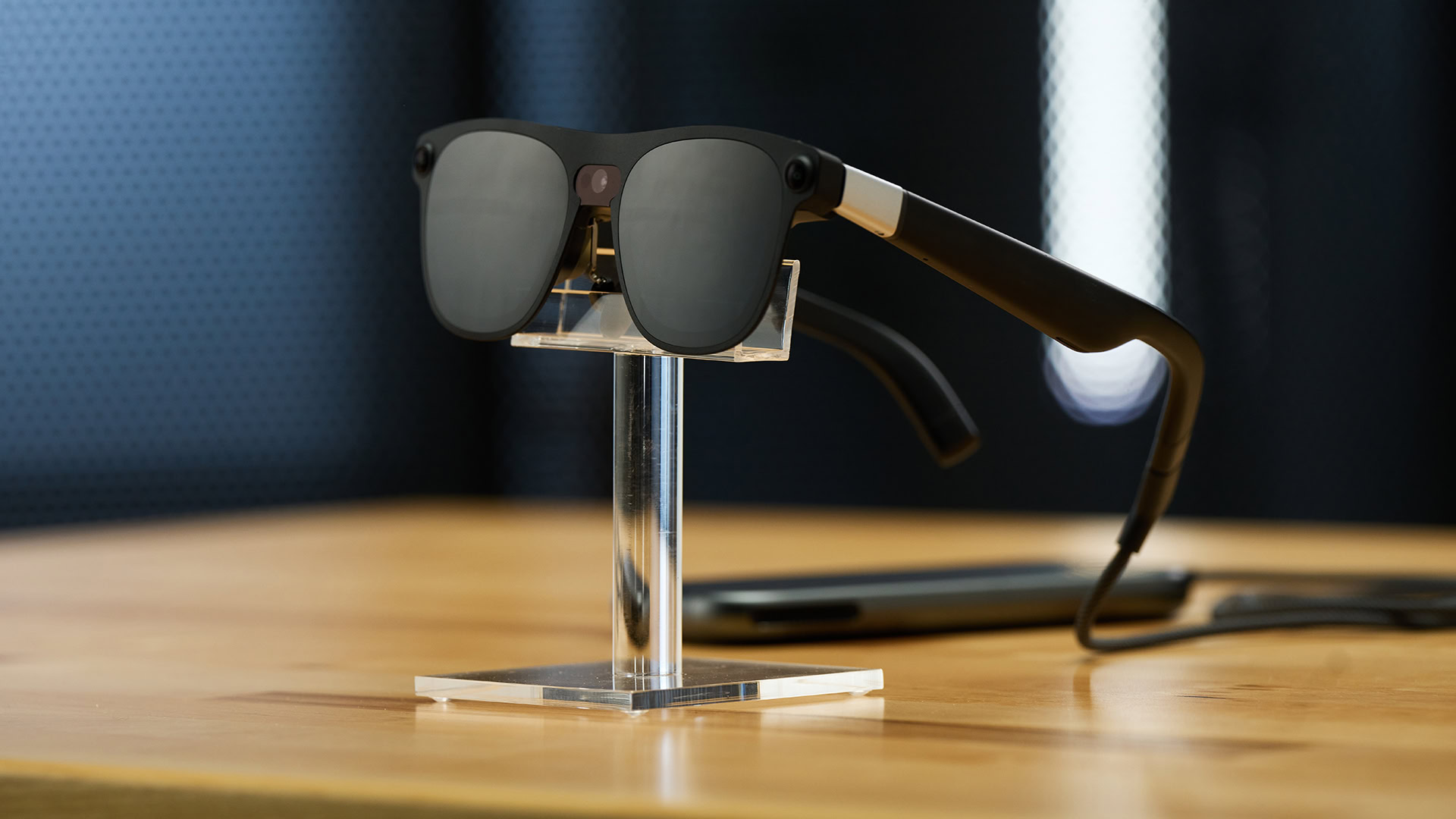
Up subsequent, Google confirmed me what was most likely probably the most thrilling prototype: a set of monocular XR glasses. Though the Android XR workforce requested me to not {photograph} them, it’s simple so that you can think about what they appear like, as a result of they’re similar to what you see within the thumbnail above, which is a good earlier prototype I used at Google I/O 2025. They’re the identical core idea as the brand new Meta Ray-Ban Show Glasses: face gear with POV cameras and a single, full-color show embedded into one of many lenses.
Like the brand new Meta Ray-Ban Show Glasses, Google’s prototypes have one show embedded in the best lens.
Proper off the bat, although, these glasses have been a lot, way more superior than what I used at I/O. The show was sharper and extra seen. The software program was easy and refined, the combination of Gemini felt pure, and it was extremely simple to determine how you can use them with little or no instruction from the Google workforce.

There are two methods to manage the glasses. The primary is through the use of the touchpad constructed into the best stem, which responds to faucets and swipes. A faucet-and-hold launches Gemini, a single faucet acts as an “OK” for on-screen UI parts, and so forth. The opposite method to management them is the way in which Google clearly prefers, which is to simply discuss with Gemini. By acquainted Gemini Reside interactions, I might “present” it what I see by the glasses and ask questions on the actual world. For instance, I might be within the kitchen taking a look at my pantry and ask Gemini to assist me with a recipe that makes use of the substances I have already got.
Don’t need to miss one of the best from Android Authority?


I even performed a Google Meet name with a Googler in one other room. I might see her completely nicely on the tiny show and listen to her clearly by the audio system within the stems that fired instantly into my ears. She couldn’t see me, in fact, however she might see what I used to be seeing by the glasses. Max Spear, the Android XR product lead at Google, advised me that he used the glasses to make a Thanksgiving dish along with his dad remotely. He wore the glasses, and his dad instructed him on what to do with a full view of Max’s kitchen.
Listening to music, conducting Google Meet calls, Maps navigation, Gemini Reside conversations — all occurring on a tiny show close to my eye.
I might additionally ask Gemini to do staple items, like take a photograph. If you take one, the shot briefly seems within the show to present you a visible affirmation {that a}) you efficiently captured the photograph, and b) what it appears like. If in case you have a Pixel Watch, it should even present the captured photograph there briefly if you happen to’d favor that. Both manner, the photograph is instantly despatched to your Google Pictures account, so you’ll be able to view it in your telephone.
Talking of which, your telephone is the actual brains of the operation. Though some very minor native computing is going on on the glasses themselves, Google isn’t even attempting to make these a standalone product. That’s why there’s no Neural Band counterpart, however Google did say it was engaged on a gesture system for Put on OS-based watches (we’ve seen hints of it already) that, crucially, wouldn’t require you to put on something you’re not already sporting. Moreover, the glasses aren’t practically as thick and heavy as the brand new Meta Ray-Ban Show Glasses.
There’s little or no lively compute on the glasses themselves. The wirelessly linked telephone is the mind.
I commented to Google about how sensible that is: most individuals within the subsequent 5-10 years gained’t depart their home with only a pair of sensible glasses and with out their telephone of their pocket, so why trouble placing any compute into the glasses themselves? The Google workforce practically erupted in cheers once I mentioned that, with one even saying, “OK, so this man will get it.”
Anyway, the software program on the glasses is the precise reverse of what Meta is providing. Right here, let me present you the distinction succinctly by displaying you Meta’s UI and Google’s. The photographs beneath present simulated pictures of Google’s UI, however as somebody who’s used the prototypes, I can verify that it’s not far off from this:
Google goes for an absolute bare-bones UI that solely reveals the data you want and nothing else. I didn’t see a launcher, nor an app drawer — simply info I wanted once I wanted it. For those who’re utilizing Maps to navigate someplace, you simply see the following course it is advisable take. If you wish to see some extra data, you tilt your head down and might then see a small map, nevertheless it goes away as quickly as you look ahead once more. For those who’re listening to music, you’ll see probably the most primary of music gamers, with the one splash of colour being a tiny album artwork sq.. For those who’re attempting to get to your Uber pick-up (Uber is an early associate with Google on this), you’ll see the core data about your driver and the pickup location in your show.

C. Scott Brown / Android Authority
The killer side of all this, although — the factor that Meta can’t even start to the touch — is that this stuff I noticed within the show weren’t Android XR apps. They have been simply repurposed ongoing notifications from the linked telephone. In different phrases, the music participant was the YouTube Music participant you see in your notification drop-down in your telephone. It wasn’t a facsimile of it — it was that precise factor, simply skinned to be extra minimalistic. The Maps have been simply grabbed from the standard notification you’d see whereas navigating. Uber — identical factor. The best way Google defined it to me, any Android developer with an current ongoing notification characteristic might have a monocular glasses expertise with only a few new API hooks. What’s extra, Google shouldn’t be vetting them beforehand: actually anybody might make certainly one of these beginning on day one.
The whole lot I noticed on the glasses got here from the linked telephone. This sounds prefer it’s too easy, however is definitely good: It is your telephone, however in your face.
I really want to emphasise how big that is. Which means if you take a pair of those glasses out of the field, it is possible for you to to right away combine them into your life. You gained’t want to go to an anemic app retailer and hope there’s greater than ten selections there, and even be hassled to re-download apps you already use. You gained’t must put on a superfluous wrist strap and make gestures within the air such as you’re casting a spell so you’ll be able to navigate to a clunky app that was tossed collectively to satisfy a deadline. Your telephone is the brains, and most of the apps there’ll already work with the glasses with out you needing to do something.

The ultimate retail model of those glasses will likely be a co-development between Google, Samsung, and conventional glasses corporations Warby Parker and Light Monster. The identify, value, and launch date are unknown for now, however Google is committing to a 2026 launch.
Oh, and there may also be a display-free model. Clearly, you’ll lose out on issues like visible Maps directions and different visual-first experiences, however Gemini, POV cameras, music, and so forth., will all nonetheless be supported. These audio-only fashions may also land in 2026 for an undisclosed value.
Binocular XR glasses
Lastly, Google gave me a really temporary demo of one thing coming within the far-off future: binocular XR glasses. Because the identify suggests, these glasses have two shows — one in every lens — that provide you with a wider subject of view for the software program content material and put it front-and-center fairly than barely to the best just like the monocular model.
For those who’re actually enthusiastic about on a regular basis XR glasses with two shows, you are going to want to attend fairly some time.
Crucially, although, having two shows permits the software program to create the phantasm of depth. I used to be proven a demo of Maps navigation with these glasses, and whereas it appeared lots like what I noticed on the monocular model, it simply felt a bit extra partaking and real looking as a result of the pins appeared to come out at me extra. I used to be additionally capable of watch a YouTube video with surprisingly good audio and visible constancy, which might be a game-changer for individuals who experience the subway to work within the morning.
Sadly, Google solely gave me a couple of minutes with these and advised me upfront that we gained’t see them in retail any time quickly. Google was cagey with particulars, nevertheless it confirmed they completely gained’t be coming in 2026, so meaning 2027 on the earliest.
Android XR glasses hands-on: The REAL future
In October, once I walked out onto the streets of Manhattan after my first time utilizing the retail-ready Galaxy XR, I bear in mind feeling little or no pleasure. I used to be way more involved about the place I used to be going to get lunch than I used to be with the expertise I had simply skilled. That is mainly as a result of the Galaxy XR is simply one other VR headset. Regardless of Google and Samsung attempting to hype it up as one thing completely different, it’s a VR headset with a number of new tips — similar to the Apple Imaginative and prescient Professional. And everyone knows how nicely the Imaginative and prescient Professional is doing (learn: not nicely in any respect).
I wasn’t too excited in regards to the Galaxy XR, however I’m actually, actually excited for on a regular basis XR glasses.
However after leaving the demo occasion with Google’s numerous XR glasses final week in San Jose, I felt elated. I really felt like I had used one thing that’s going to be a serious side of our lives sooner or later. Google may not hit a grand slam proper out of the gate with these in 2026, however the core thought is there. Good glasses are the long run, and Google is now the corporate I most suspect will likely be on the forefront of that future.
And that brings me again to the place I began with this text: Meta. Google’s XR glasses have already solved two of the numerous issues with Meta’s glasses — they usually’re not even out but. They may have a strong software program expertise proper out of the field with gamers from Google, shut companions like Uber, after which just about another Android developer who needs to get on board. This stands in stark distinction to Meta’s “you solely get Meta apps” nonsense with the Meta Ray-Ban Show Glasses. Likewise, the glasses run on Gemini, which is, for my part, one of the best generative AI expertise in the marketplace proper now (even ChatGPT’s dad or mum firm is beginning to admit feeling the warmth from Gemini). Even when Gemini wasn’t one of the best, it’s head and shoulders above something Meta has produced.
That leaves us on the third downside with Meta’s ambitions, which is Meta itself. Is Google any higher than Meta in the meanwhile? Certain, most individuals I do know don’t hate Google as passionately as they do Meta, however there are nonetheless tons of people that mistrust the corporate. Are we prepared for a future the place you put on a face laptop that Google has deep management over? Are you prepared for Google to, fairly actually, peer into your life?
Are we prepared for Google to be on our faces each waking second of the day?
I had a pleasant, lengthy chat with Google reps after my demo about these heavy subjects, they usually mentioned they’re taking them very significantly. The glasses will all have a distinguished on/off swap. When within the “off” place, that swap will likely be distinctly pink in colour to sign to everybody, “My spy glasses aren’t on proper now, guys.” There’s additionally an LED gentle on the entrance that indicators when the cameras are capturing any sort of info, and any makes an attempt to cowl up the LED will render the cameras inoperable. Google additionally advised me it’s working exhausting to develop clear privateness statutes which can be proven early and sometimes to the consumer, in order that they know (and might management) every thing Google will get from them.
This was all comforting to listen to, however Google has constructed a foul repute over the previous few years for an entire slew of causes that I gained’t get into. Suffice it to say that the corporate might want to work time beyond regulation to persuade the lots that it will likely be accountable with its new face computer systems. If it may do this, although? I foresee Google in a short time usurping Meta on this area — and the sky’s the restrict from there.
Thanks for being a part of our neighborhood. Learn our Remark Coverage earlier than posting.